
Professional Supervision, Quality Control, and Progress Monitoring for Steel Building Projects
Construction monitoring is one of the most important stages of a steel building construction project. A well-prepared design and high-quality materials alone cannot guarantee a successful project unless construction activities are properly supervised, inspected, documented, and monitored throughout the implementation process.
At [Company Name], we provide systematic construction monitoring and supervision to ensure that steel building projects are constructed according to approved drawings, specifications, quality requirements, safety standards, project schedules, and client expectations.
Our objective is to maintain quality, safety, cost control, schedule compliance, and proper coordination from the beginning of construction through final handover.
What Is Construction Monitoring?
Construction monitoring is the continuous process of observing, inspecting, verifying, documenting, and reporting construction activities throughout a project.
For steel building construction, monitoring may cover:
- Site preparation
- Foundation construction
- Anchor-bolt installation
- Steel fabrication
- Steel erection
- Welding and bolting
- Roofing and cladding
- Electrical installation
- Plumbing installation
- Civil works
- Painting and corrosion protection
- Safety compliance
- Material quality
- Project progress
- Final inspection
Regular monitoring helps identify problems early, allowing corrective action before they become expensive or difficult to resolve.
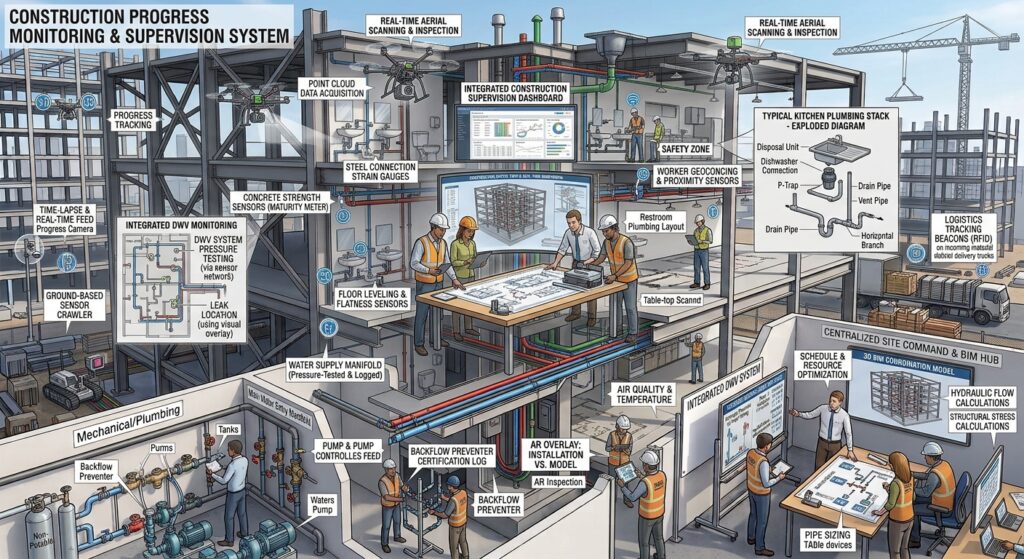
Why Construction Monitoring Is Important
Steel buildings involve multiple specialized activities that must be executed in the correct sequence. Even a relatively small error in foundation positioning, anchor-bolt alignment, steel erection, connection installation, or roofing can affect later construction activities.
Professional monitoring helps ensure:
Quality: Construction follows approved specifications and standards.
Safety: Workers and site activities follow appropriate safety procedures.
Schedule: Work progresses according to the agreed project timeline.
Cost Control: Errors, rework, wastage, and unnecessary changes can be minimized.
Structural Integrity: Critical structural elements are installed correctly.
Coordination: Civil, structural, electrical, plumbing, and other services work together properly.
Documentation: Construction activities and decisions are properly recorded.
Our Construction Monitoring Process
1. Pre-Construction Review
Before physical construction begins, we review the project documentation and establish the monitoring requirements.
This may include reviewing:
- Architectural drawings
- Structural drawings
- Steel fabrication drawings
- Foundation drawings
- Electrical drawings
- Plumbing drawings
- Mechanical drawings
- Material specifications
- Project schedule
- Bill of quantities
- Construction methodology
- Quality requirements
- Safety requirements
Any inconsistencies or potential construction difficulties can be identified before work begins.
2. Site Preparation Monitoring
The construction site must be properly prepared before foundation and structural work starts.
Monitoring may include:
- Site clearing
- Site leveling
- Setting-out activities
- Access arrangements
- Temporary facilities
- Material storage
- Drainage arrangements
- Site safety measures
Proper site preparation establishes the foundation for efficient project execution.
3. Foundation and Civil Work Monitoring
Although the building structure may be made primarily from steel, the foundation is a critical component of the overall structural system.
We monitor key activities such as:
- Excavation
- Soil preparation
- Reinforcement installation
- Formwork
- Concrete placement
- Foundation dimensions
- Foundation levels
- Anchor-bolt positioning
- Concrete curing
- Floor slab preparation
Special attention is given to anchor-bolt locations because inaccuracies can create significant problems during steel erection.
4. Steel Fabrication Monitoring
Steel components are normally fabricated before they arrive at the construction site.
Monitoring may include verification of:
- Steel material specifications
- Member dimensions
- Plate thickness
- Cutting
- Drilling
- Welding
- Connection plates
- Bolt holes
- Surface preparation
- Protective coating
- Component identification
Proper fabrication quality helps ensure that steel members fit correctly during site erection.
5. Material Inspection
Construction monitoring includes checking materials delivered to the site against approved specifications.
Depending on the project, materials may include:
- Structural steel
- High-strength bolts
- Welding consumables
- Roofing sheets
- Wall cladding
- Insulation
- Reinforcement steel
- Cement
- Aggregates
- Electrical materials
- Plumbing materials
- Fasteners
- Paint and protective coatings
Material inspections help prevent unsuitable or incorrect materials from being incorporated into the project.
6. Steel Erection Monitoring
Steel erection is one of the most critical stages of a steel building project.
Monitoring focuses on:
- Erection sequence
- Column positioning
- Beam installation
- Bracing
- Temporary stability
- Bolt installation
- Connection alignment
- Verticality
- Level and dimensions
- Crane operations
- Worker safety
The erection process must follow an appropriate sequence to maintain structural stability throughout construction.
7. Bolted Connection Inspection
Bolted connections are critical structural components of many steel buildings.
Monitoring may include checking:
- Correct bolt type
- Bolt diameter
- Bolt grade
- Number of bolts
- Bolt placement
- Washer and nut arrangement
- Tightening procedures
- Connection condition
Where specified, appropriate inspection or verification procedures should be followed to confirm that connections meet the project requirements.
8. Welding Inspection
Where welded connections are used, welding quality must be carefully monitored.
Inspection may consider:
- Welding procedure
- Welder qualifications where required
- Joint preparation
- Welding consumables
- Weld size
- Weld appearance
- Welding sequence
- Defects
- Required inspection or testing
Additional non-destructive testing may be specified for critical welds depending on the structural design and applicable standards.
9. Alignment and Dimensional Monitoring
Accurate alignment is essential for steel building performance.
We monitor:
- Column verticality
- Building dimensions
- Grid alignment
- Beam levels
- Roof alignment
- Connection positions
- Opening dimensions
- Structural tolerances
Surveying equipment and appropriate measurement methods may be used to verify the structural geometry.
10. Roofing and Wall Cladding Monitoring
After the primary steel frame is erected, roofing and wall cladding installation becomes an important stage.
Monitoring may cover:
- Roof-sheet installation
- Wall panels
- Fasteners
- Flashings
- Ridge caps
- Gutters
- Downpipes
- Insulation
- Sealing
- Overlaps
- Weatherproofing
Proper installation helps prevent water leakage, corrosion, thermal problems, and premature deterioration.
11. Electrical and Plumbing Monitoring
Construction monitoring should extend beyond the structural steelwork.
Electrical and plumbing installations are reviewed for coordination with the building design.
This may include:
- Cable tray installation
- Electrical conduits
- Lighting installation
- Distribution boards
- Earthing
- Water-supply piping
- Drainage piping
- Sanitary fixtures
- Pumps
- Roof drainage
- Equipment connections
Services should be installed without damaging or improperly modifying structural steel components.
12. Quality Control and Inspection
Quality control is maintained throughout the project rather than being performed only at the end.
Inspection activities may include:
- Incoming material inspection
- Workmanship inspection
- Dimensional checks
- Connection inspection
- Coating inspection
- Roofing inspection
- Concrete inspection
- Service installation inspection
- Final finishing inspection
Defects or deviations are documented and corrective actions are followed up.
13. Construction Progress Monitoring
Project progress is regularly compared with the approved construction schedule.
We monitor:
- Planned activities
- Completed activities
- Current work progress
- Delayed activities
- Material availability
- Labor deployment
- Equipment availability
- Upcoming activities
Regular progress monitoring allows project stakeholders to identify delays early and take corrective measures.
14. Site Safety Monitoring
Safety is an essential component of steel building construction monitoring.
Particular attention is given to activities involving:
- Working at height
- Crane operations
- Steel lifting
- Welding
- Cutting
- Electrical work
- Scaffolding
- Temporary structures
- Material handling
Safety monitoring may also include appropriate use of:
- Helmets
- Safety harnesses
- Safety shoes
- Gloves
- Eye protection
- Reflective vests
- Fall-protection systems
The specific safety requirements should be established according to the project conditions and applicable regulations.
15. Coordination Between Contractors
Steel building projects may involve several specialized contractors.
Construction monitoring helps coordinate:
- Civil contractors
- Steel fabricators
- Steel erection teams
- Roofing contractors
- Electrical contractors
- Plumbing contractors
- HVAC contractors
- Fire-protection contractors
- Finishing contractors
Effective coordination reduces clashes, delays, duplication of work, and unnecessary rework.
16. Problem Identification and Corrective Action
Construction problems can occur even with careful planning.
Common issues may include:
- Incorrect dimensions
- Misaligned anchor bolts
- Damaged steel members
- Improper connections
- Material shortages
- Coating damage
- Roofing leakage
- Service clashes
- Delayed material delivery
- Poor workmanship
Our monitoring process focuses on identifying such issues early, documenting them, discussing appropriate corrective measures, and following up until resolution.
17. Daily and Periodic Site Reports
Professional construction monitoring should be supported by proper documentation.
Depending on the project requirements, reports may include:
- Daily site reports
- Weekly progress reports
- Monthly progress reports
- Inspection reports
- Material inspection reports
- Safety observations
- Non-conformance reports
- Progress photographs
- Meeting minutes
- Corrective-action records
These records provide transparency and create a useful project history.
18. Photography and Visual Documentation
Photographic documentation is an effective way to record construction progress.
Photographs can document:
- Foundation progress
- Steel delivery
- Steel fabrication
- Erection activities
- Structural connections
- Roofing installation
- Electrical and plumbing work
- Finishing activities
- Defects
- Corrective actions
- Final completion
Organized photographs can also be useful for project reporting and future reference.
19. Final Inspection and Snagging
Before handover, a detailed inspection is conducted to identify outstanding work.
A snagging process may identify:
- Structural finishing issues
- Damaged panels
- Paint defects
- Roof leakage concerns
- Incomplete electrical work
- Plumbing defects
- Missing fixtures
- Door and window issues
- Drainage problems
- Safety-signage requirements
- Other incomplete works
The contractor can then address the identified items before final handover.
20. Final Handover and Documentation
At project completion, construction monitoring supports the preparation and collection of important documentation.
Depending on the project, this may include:
- As-built drawings
- Structural drawings
- Electrical drawings
- Plumbing drawings
- Equipment manuals
- Warranty documents
- Material certificates
- Inspection records
- Test reports
- Maintenance information
- Completion photographs
- Final snagging records
Proper documentation makes future maintenance and facility management easier.
Benefits of Professional Construction Monitoring
Better Quality
Regular inspections help ensure that construction work meets the required specifications.
Reduced Rework
Problems are identified early before they become more expensive to correct.
Better Schedule Control
Regular progress tracking helps identify potential delays.
Improved Safety
Site activities can be monitored to identify unsafe practices and conditions.
Cost Protection
Proper supervision can help reduce material wastage, construction errors, and unnecessary rework.
Better Coordination
Multiple construction disciplines can be coordinated more effectively.
Transparent Reporting
Regular reports provide the client with a clear understanding of project progress.
Technology in Construction Monitoring
Modern construction projects can benefit from digital monitoring tools and technologies.
Depending on project requirements, monitoring may incorporate:
- Digital progress reports
- Mobile inspection systems
- Cloud-based documentation
- Digital drawings
- Photo-based progress tracking
- BIM coordination
- Drone photography where appropriate
- Digital checklists
- Online project communication
- Document management systems
These technologies can improve communication, documentation, and project visibility.
Our Integrated Monitoring Approach
At [Company Name], construction monitoring is not limited to checking whether work is progressing. We focus on the overall performance of the project.
Our monitoring approach considers:
Design → Materials → Fabrication → Foundation → Steel Erection → Roofing & Cladding → MEP Services → Finishing → Testing → Snagging → Handover
By monitoring each stage systematically, we help clients maintain better control over quality, schedule, safety, and project execution.
Conclusion
Construction monitoring plays a vital role in ensuring the successful delivery of a steel building project. From foundation work and steel fabrication to erection, roofing, electrical and plumbing installation, finishing, testing, and final handover, every stage requires proper inspection and coordination.
A professionally monitored construction project provides greater confidence that the building is being constructed according to the approved design, required specifications, safety requirements, and agreed project objectives.
At [Company Name], our construction monitoring service is designed to provide clients with greater transparency, quality assurance, technical coordination, and confidence throughout the entire steel building construction process.
