
Professional Support for Environmental Clearance, Compliance, and Sustainable Industrial Development
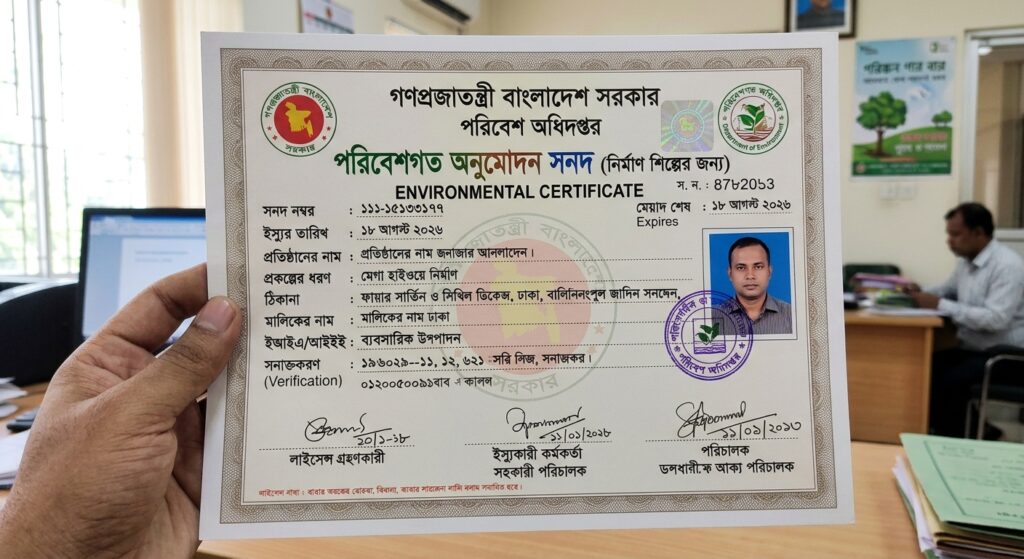
Environmental compliance is an important part of establishing a factory, warehouse, manufacturing facility, workshop, or other industrial building in Bangladesh. For many industrial projects, obtaining an Environmental Clearance Certificate (ECC) from the Department of Environment (DoE) is a necessary regulatory step before establishing or operating the project.
For steel building construction, environmental requirements should be considered during the planning and design stage rather than after construction is completed. The building, production process, machinery, wastewater, emissions, noise, waste management, drainage, and surrounding environment may all influence the approval requirements.
According to BIDA’s investment guidance, factories in Bangladesh are required to obtain environmental clearance from the Department of Environment, with industrial projects classified according to their potential environmental impact.
At [Company Name], we provide environmental permission and documentation support to help clients understand applicable requirements, prepare project information, coordinate technical documents, and proceed with the environmental clearance process in an organized manner.
What Is Environmental Clearance?
Environmental Clearance Certificate (ECC) is an approval issued by the Department of Environment for applicable industrial units and projects after reviewing their environmental requirements and compliance measures.
The environmental clearance process considers factors such as:
- Project location
- Nature of the industry
- Production process
- Raw materials
- Machinery
- Waste generation
- Wastewater discharge
- Air emissions
- Noise
- Hazardous materials
- Environmental risks
- Pollution-control measures
The exact requirements depend on the project’s category and current environmental regulations.
Environmental Classification of Industrial Projects
Industrial projects are classified according to their potential environmental impact. The current environmental framework uses categories including:
- Green
- Orange-A
- Orange-B
- Red
The applicable category determines the level of environmental assessment, documentation, review, and clearance required.
Therefore, one of the first steps in environmental permission support is to identify the appropriate category of the proposed industrial project.
Why Environmental Permission Is Important
Environmental clearance is not simply a documentation requirement. It helps ensure that industrial development is planned with appropriate controls for environmental risks.
Professional environmental compliance can help provide:
Regulatory Compliance: Supports compliance with applicable environmental requirements.
Pollution Control: Helps identify and control potential sources of air, water, noise, and other pollution.
Project Approval: Environmental clearance may be required before establishing or operating applicable industrial projects.
Risk Reduction: Helps reduce the possibility of regulatory objections, penalties, or operational disruption.
Sustainable Development: Encourages responsible use of water, energy, land, and other resources.
Better Project Planning: Environmental requirements can be incorporated into the building and factory design from the beginning.
Our Environmental Permission Process
1. Initial Project Assessment
We begin by understanding the proposed project and its environmental characteristics.
The assessment may include:
- Project location
- Land area
- Steel building size
- Factory or warehouse type
- Production process
- Raw materials
- Finished products
- Machinery
- Production capacity
- Number of workers
- Water consumption
- Wastewater generation
- Solid-waste generation
- Air emissions
- Noise sources
- Fuel use
- Chemical storage
- Surrounding land use
This information helps determine the likely environmental approval pathway.
2. Environmental Category Identification
The proposed industry is reviewed against the applicable environmental classification.
This is important because the requirements for a relatively low-impact project can be significantly different from those for a project with substantial environmental risks.
For Orange and Red category projects, the environmental approval process can involve additional assessment and documentation compared with simpler categories.
3. Site and Location Assessment
Environmental suitability of the proposed location is an important consideration.
The site may be reviewed for:
- Nearby residential areas
- Schools
- Hospitals
- Water bodies
- Agricultural land
- Drainage
- Existing industries
- Roads
- Sensitive environmental areas
- Waste-disposal arrangements
- Water sources
Site information helps determine potential environmental impacts and required mitigation measures.
4. Collection of Project Documents
Environmental applications require accurate project information and supporting documents.
Depending on the project category and current requirements, documents may include:
- Company information
- Trade license
- Land documents
- Site plan
- Location map
- Building plan
- Factory layout
- Machinery list
- Production process
- Raw-material list
- Finished-product information
- Water requirement
- Waste-management information
- Fire-safety documentation
- Local authority NOC
- Environmental reports
- Other supporting documents
The Department of Environment provides category-specific requirements and application guidance through its environmental clearance system.
5. Site Plan and Factory Layout
The environmental application should clearly communicate how the industrial facility will operate.
The layout may identify:
- Production areas
- Raw-material storage
- Finished-goods storage
- Machinery
- Boiler or generator areas
- Chemical storage
- Waste-storage areas
- ETP/STP where applicable
- Drainage
- Water sources
- Administrative areas
- Worker facilities
- Green areas
A properly prepared layout helps demonstrate how environmental risks will be managed.
6. Production Process Flow
For manufacturing projects, the production process should be clearly documented.
A process-flow diagram may show:
Raw Materials → Processing → Manufacturing → Quality Control → Finished Products → Storage → Dispatch
Environmental inputs and outputs can also be identified, including:
- Water consumption
- Energy consumption
- Wastewater
- Solid waste
- Air emissions
- Noise
- Hazardous waste
This information helps determine appropriate environmental management measures.
7. Environmental Management Plan
An Environmental Management Plan (EMP) may be required depending on the project category and applicable requirements.
An EMP can address:
- Wastewater management
- Air-pollution control
- Noise control
- Solid-waste management
- Hazardous-waste management
- Chemical handling
- Worker safety
- Emergency response
- Environmental monitoring
- Water management
- Energy management
For projects requiring more extensive assessment, additional environmental studies may be necessary.
8. Initial Environmental Examination and Environmental Impact Assessment
Depending on the project’s classification and environmental risk, environmental assessment may be required.
For higher-impact projects, the process may involve:
- Terms of Reference
- Initial Environmental Examination where applicable
- Environmental Impact Assessment
- Environmental Management Plan
- Environmental monitoring
- Mitigation measures
For Red-category projects, the DoE describes a process involving approval of EIA Terms of Reference, preparation and approval of the EIA, and implementation of required environmental measures before final environmental clearance.
9. Wastewater and Effluent Management
Industrial wastewater can be one of the most important environmental considerations.
Depending on the industry, wastewater may originate from:
- Production processes
- Equipment cleaning
- Worker facilities
- Washing operations
- Chemical processes
- Boiler operations
- Cooling systems
Where treatment is required, an Effluent Treatment Plant (ETP) may be incorporated into the project.
The appropriate treatment system depends on the characteristics and quantity of the wastewater.
10. Sewage Treatment
Factories and large industrial facilities generate domestic wastewater from:
- Toilets
- Washrooms
- Worker facilities
- Kitchens
- Administrative areas
Depending on the project and site infrastructure, appropriate sewage treatment or disposal arrangements may be required.
For larger developments, an STP (Sewage Treatment Plant) may be considered where applicable.
11. Air Pollution and Emission Control
Industrial activities may generate air emissions from:
- Boilers
- Generators
- Furnaces
- Production machinery
- Dust-generating processes
- Welding
- Cutting
- Material handling
Depending on the process, environmental control measures may include:
- Dust collectors
- Filters
- Exhaust systems
- Ventilation
- Emission-control equipment
- Stack arrangements
The actual control system should be designed according to the specific process and applicable requirements.
12. Noise Pollution Management
Steel factories and industrial facilities can generate noise from:
- Heavy machinery
- Compressors
- Generators
- Cutting equipment
- Welding equipment
- Material handling
- Vehicles
Noise-control measures may include:
- Equipment isolation
- Acoustic enclosures
- Sound barriers
- Proper equipment maintenance
- Controlled operating arrangements
- Suitable building design
Environmental monitoring may be required depending on the project.
13. Solid-Waste Management
Industrial projects should establish a suitable system for collecting, storing, recycling, treating, and disposing of solid waste.
Potential waste streams may include:
- Steel scrap
- Packaging materials
- Plastic
- Paper
- General waste
- Production waste
- Sludge
- Hazardous waste
Where possible, recyclable materials should be segregated and recovered through appropriate channels.
14. Hazardous Chemical Management
Some industrial projects use chemicals, fuels, oils, paints, solvents, or other potentially hazardous substances.
Environmental planning may consider:
- Chemical storage
- Secondary containment
- Spill prevention
- Safety data sheets
- Emergency response
- Waste disposal
- Fire safety
- Worker protection
Where hazardous chemicals are involved, additional permissions or clearances may apply depending on the substance and its use.
15. Local Authority NOC
A local authority’s No Objection Certificate may be part of the environmental clearance documentation, depending on the project and applicable requirements.
The DoE’s current FAQ indicates that the local authority NOC is obtained from the relevant local government authority, such as the Union Parishad Chairman or City Corporation Mayor/Councillor, according to the applicable process.
16. Online Environmental Clearance Application
The Department of Environment provides an online Environmental Clearance Certificate application system.
Applications can be submitted through:
DoE Environmental Clearance System
The DoE FAQ confirms that applicants can use the online system for environmental clearance applications.
The submission procedure and supporting-document requirements depend on the project category.
17. Application Submission and Documentation
Our support can include:
- Application information preparation
- Document checklist
- Project information compilation
- Drawing coordination
- Environmental report coordination
- Fee/payment documentation
- Online application support
- Submission support
- Authority communication
- Revision support
The DoE’s current system indicates that Orange-B and Red category applications require hard-copy submission of the application and supporting documents in addition to the online process, while Green and Orange-A applications do not require hard-copy submission under the stated procedure.
18. Environmental Inspection
The Department of Environment may inspect the project or facility as part of its regulatory process.
Inspection may consider:
- Factory layout
- Production activities
- Wastewater management
- ETP/STP
- Waste storage
- Chemical storage
- Air emissions
- Noise
- Drainage
- Environmental safeguards
- Overall compliance
We help clients prepare the facility and documentation for applicable inspections.
19. Corrective Action and Compliance
If environmental deficiencies are identified, corrective actions may be necessary.
These could involve:
- Installing or improving wastewater treatment
- Improving waste storage
- Controlling emissions
- Reducing noise
- Improving drainage
- Establishing waste segregation
- Improving chemical storage
- Implementing environmental monitoring
- Updating environmental documentation
Our role is to help identify the requirements and coordinate appropriate technical solutions.
20. Environmental Clearance Certificate
After the applicable review and compliance process, the Environmental Clearance Certificate may be issued by the Department of Environment.
The certificate should be carefully preserved along with:
- Approved environmental documents
- Environmental reports
- Drawings
- Conditions of approval
- Testing reports
- Monitoring records
- Renewal documentation
The ECC is not simply a one-time document; ongoing compliance with its conditions is important.
21. Environmental Clearance Renewal
Environmental clearance may need periodic renewal depending on the project’s category and applicable rules.
The DoE’s current FAQ states that Green-category clearance has a three-year validity, while Orange-A, Orange-B, and Red category clearances have one-year validity under the cited framework.
The DoE also advises applicants to apply for renewal before expiry. The current FAQ indicates one month before expiry.
Because regulations and procedures can change, the current validity and renewal requirements should always be verified before filing.
Environmental Permission for Steel Factories
Steel factories may involve several environmental considerations, including:
- Steel cutting
- Welding
- Grinding
- Painting
- Surface treatment
- Dust
- Noise
- Scrap generation
- Used oil
- Chemical storage
- Generator emissions
- Worker facilities
The actual environmental requirements depend on the specific manufacturing process and classification.
Environmental Permission for Steel Warehouses
A simple storage warehouse may have a different environmental profile from a manufacturing factory.
However, environmental considerations can still include:
- Stored materials
- Chemical or hazardous-material storage
- Waste generation
- Vehicle movement
- Drainage
- Sanitation
- Fire-water management
- Noise
- Stormwater
The environmental classification should be determined based on the actual proposed activity rather than the building’s steel structure alone.
Environmental Design Coordination with Steel Building Construction
Environmental requirements should be incorporated into the building design at an early stage.
For example:
Steel Structure
↓
Factory Layout
↓
Production Process
↓
Wastewater & Drainage
↓
ETP/STP
↓
Waste Management
↓
Air & Noise Control
↓
Fire & Safety
↓
Environmental Clearance
Early coordination can prevent costly modifications after the building has already been constructed.
Documents We Can Help Prepare
Depending on the project, our environmental permission support may include:
- Project profile
- Company information
- Site plan
- Location map
- Factory layout
- Building drawings
- Machinery list
- Production process flow
- Raw-material list
- Finished-product list
- Water-consumption statement
- Wastewater information
- Waste-management plan
- Environmental Management Plan
- IEE/EIA coordination where applicable
- ETP/STP information
- Air-emission information
- Noise-management information
- Local authority NOC coordination
- Application documentation
- Renewal documentation
Benefits of Professional Environmental Permission Support
Better Regulatory Preparation
Helps identify the applicable environmental requirements before construction or operation.
Reduced Documentation Errors
Ensures project information and supporting documents are organized consistently.
Technical Coordination
Environmental requirements can be coordinated with architectural, structural, electrical, plumbing, and factory planning.
Inspection Readiness
Helps prepare the facility for applicable environmental inspections.
Improved Environmental Performance
Encourages proper management of wastewater, waste, emissions, noise, and other environmental impacts.
Long-Term Compliance
Supports renewal and ongoing environmental monitoring requirements.
Important Note
Environmental clearance requirements in Bangladesh are project-specific. The applicable category, documents, studies, fees, approval sequence, inspection requirements, and renewal conditions depend on the industry, location, environmental impact, and current laws and regulations.
The Department of Environment’s current online system and published guidance should be checked before submitting an application. The DoE provides current application information, category guidance, and document requirements through its environmental clearance system.
Conclusion
Environmental authority permission is an important part of developing a compliant industrial steel building in Bangladesh. From initial environmental assessment and project classification to documentation, environmental studies, pollution-control planning, online application, inspection, clearance, and renewal, each stage requires careful attention.
At [Company Name], we support clients in coordinating environmental permission requirements with the overall steel building development process.
Our integrated approach connects:
Project Assessment → Environmental Classification → Site & Factory Planning → Environmental Documentation → Application → Inspection → Corrective Action → Environmental Clearance → Renewal & Compliance
Through proper environmental planning, clients can develop industrial facilities that are not only structurally sound and operationally efficient, but also more responsible toward workers, surrounding communities, and the environment.
