
Strong Foundations for Safe, Stable, and Long-Lasting Steel Buildings
A strong and properly designed foundation is the foundation of every successful steel building project. When the existing soil does not have sufficient bearing capacity to safely support the building loads, piling may be required to transfer structural loads to deeper, stronger soil or rock strata.
At [Company Name], piling is treated as a critical part of the overall structural and foundation engineering process. We coordinate geotechnical investigation, pile design, piling execution, testing, pile-cap construction, and structural requirements to develop a reliable foundation solution for steel buildings.
What Is Piling?
Piling is a deep-foundation technique in which long structural elements, known as piles, are installed deep into the ground to transfer building loads to suitable soil or rock layers.
Piles can transfer loads through:
- End bearing
- Skin friction
- Or a combination of both
The appropriate piling system depends on the soil conditions, building loads, groundwater conditions, site restrictions, pile capacity requirements, and applicable engineering standards.
Why Piling May Be Required for Steel Buildings
Steel buildings can be relatively lightweight compared with some reinforced-concrete structures, but industrial steel buildings may still impose substantial concentrated loads through columns, machinery, cranes, storage systems, and other equipment.
Piling may be considered where:
- Near-surface soil has low bearing capacity
- Weak or compressible soil exists at shallow depth
- Heavy column loads need to be supported
- Differential settlement must be controlled
- Groundwater conditions affect shallow foundations
- The project requires deep foundation support
- Site-specific geotechnical conditions make shallow foundations unsuitable
The final decision to use piles should always be based on geotechnical investigation and structural foundation design.
Our Piling Process
1. Soil Investigation
A proper geotechnical investigation is one of the most important steps before designing a piling system.
Soil investigation may provide information regarding:
- Soil layers
- Soil bearing characteristics
- Soil strength
- Groundwater level
- Soil density
- Settlement characteristics
- Depth of competent strata
- Possible geotechnical risks
In Bangladesh, where soil conditions can vary significantly from one location to another, site-specific investigation is particularly important.
2. Pile Design
Based on the geotechnical investigation and structural loads, engineers determine the appropriate pile type, diameter, depth, spacing, and capacity.
The design may consider:
- Axial compression loads
- Tension loads where applicable
- Lateral loads
- Structural column loads
- Wind loads
- Equipment loads
- Settlement requirements
- Soil conditions
- Pile group behavior
The pile design is coordinated with the steel building’s column grid and foundation arrangement.
3. Selection of Pile Type
Different piling systems may be suitable for different project conditions.
Potential options include:
- Bored cast-in-situ piles
- Driven precast concrete piles
- Driven steel piles
- Other specialized deep-foundation systems
The selection depends on soil conditions, equipment availability, project size, environmental considerations, access, noise and vibration restrictions, and design requirements.
4. Site Preparation
Before piling begins, the site must be properly prepared.
Site preparation may include:
- Clearing and leveling
- Working-platform preparation
- Access-road preparation
- Surveying
- Pile-point marking
- Equipment positioning
- Temporary drainage
- Material storage
- Safety arrangements
A stable working platform is especially important for piling rigs and heavy construction equipment.
5. Setting Out Pile Locations
Accurate positioning of piles is essential.
Surveying teams establish the building grid and mark the exact pile locations according to approved foundation drawings.
The pile positions are checked against:
- Structural grid lines
- Column locations
- Pile-cap dimensions
- Foundation drawings
- Required tolerances
Incorrect pile positioning can create problems during pile-cap and steel-column installation.
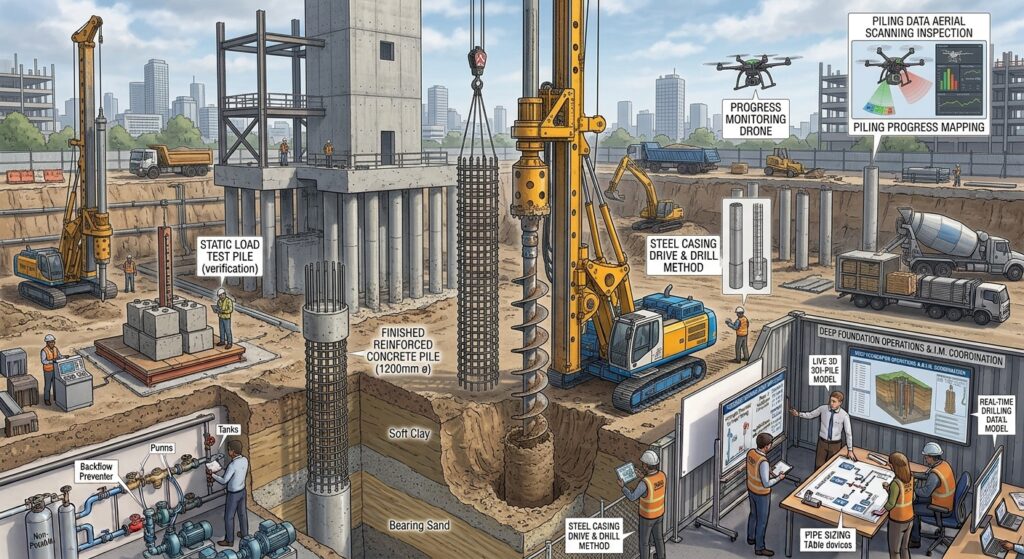
6. Pile Installation
The installation procedure depends on the selected pile type.
Bored Cast-in-Situ Piles
For bored piles, the general process may involve:
- Setting out the pile location
- Positioning the piling rig
- Drilling or boring to the required depth
- Stabilizing the borehole where necessary
- Cleaning the pile base
- Installing reinforcement cage
- Placing concrete
- Completing the pile
- Recording installation information
The actual procedure should follow the approved piling method statement and engineering requirements.
Driven Piles
For driven piles, pile sections are installed into the ground using appropriate driving equipment.
Monitoring may include:
- Pile location
- Driving sequence
- Driving resistance
- Pile penetration
- Equipment performance
- Pile integrity
- Installation records
The driving method should be controlled to avoid damage to the piles and surrounding structures.
7. Piling Quality Control
Quality control is essential throughout piling operations.
Monitoring may cover:
- Pile diameter
- Pile depth
- Verticality
- Reinforcement
- Concrete quality
- Concrete volume
- Pile location
- Installation sequence
- Ground conditions
- Equipment performance
Installation records should be maintained for each pile.
8. Reinforcement Cage Inspection
For reinforced concrete piles, reinforcement cages are inspected before concrete placement.
Inspection may verify:
- Bar diameter
- Number of bars
- Bar spacing
- Cage dimensions
- Links or ties
- Lap lengths
- Reinforcement positioning
- Concrete cover
- Cage length
Proper reinforcement placement is important for achieving the required structural performance.
9. Concrete Quality Control
Concrete is a critical component of cast-in-situ piling.
Quality control may include:
- Approved concrete mix
- Concrete grade
- Slump testing
- Concrete delivery records
- Placement procedure
- Concrete quantity
- Continuous placement where required
- Sample collection
- Strength testing
Proper concrete placement helps minimize defects and ensures the pile achieves its intended capacity.
10. Pile Testing
Pile testing provides important information about the performance and integrity of the installed piles.
Depending on the design and applicable requirements, testing may include:
Static Load Testing
Static load testing evaluates the behavior of a pile under controlled loading.
It can provide information regarding:
- Load capacity
- Settlement
- Load-displacement behavior
- Performance under specified loading conditions
Dynamic Load Testing
Dynamic testing may be used for appropriate pile types to assess pile performance during or after installation.
Pile Integrity Testing
Integrity testing can help identify potential abnormalities within piles, such as significant changes in cross-section or possible discontinuities.
The specific testing program should be established by the project engineer based on the foundation design and applicable standards.
11. Pile Cut-Off and Head Preparation
After pile installation and required testing, pile heads are prepared to the specified level.
This may involve:
- Removing weak or contaminated concrete
- Cutting the pile to the required level
- Exposing reinforcement
- Cleaning the pile head
- Preparing the connection with the pile cap
Proper pile-head preparation is important for achieving effective load transfer.
12. Pile Cap Construction
Piles generally work together through pile caps or other foundation elements.
Pile-cap construction may involve:
- Excavation
- Blinding concrete
- Reinforcement installation
- Pile-head preparation
- Formwork
- Concrete placement
- Curing
- Waterproofing where required
The pile cap transfers loads from the steel building columns into the pile group.
13. Coordination with Steel Building Columns
One of the most important aspects of piling for steel buildings is coordination between the deep foundation and the steel structural system.
Pile caps must be accurately positioned according to the structural column grid.
Particular attention is given to:
- Column centerlines
- Anchor-bolt locations
- Base-plate dimensions
- Foundation levels
- Pile-cap dimensions
- Structural load paths
Accurate coordination helps ensure that steel columns can be installed without unnecessary modifications.
14. Piling Monitoring and Documentation
Professional piling work should be supported by detailed documentation.
Project records may include:
- Pile layout drawings
- Pile installation records
- Pile depth records
- Concrete records
- Reinforcement inspection records
- Pile testing reports
- Survey records
- Site photographs
- Non-conformance reports
- Corrective-action records
- As-built pile locations
These documents provide valuable evidence of foundation quality and support future maintenance or structural assessment.
15. Safety During Piling Operations
Piling involves heavy equipment, deep excavations, lifting operations, concrete work, and significant ground activity.
Safety monitoring may cover:
- Piling rig operations
- Crane and lifting operations
- Equipment movement
- Excavations
- Working platforms
- Electrical systems
- Concrete operations
- Reinforcement handling
- Restricted-access zones
- Personal protective equipment
A project-specific safety plan should be implemented according to site conditions and applicable regulations.
16. Environmental Considerations
Piling operations can generate noise, vibration, spoil, slurry, dust, and construction waste.
Depending on the piling method, environmental controls may include:
- Noise management
- Vibration monitoring
- Spoil disposal
- Slurry management
- Dust control
- Water management
- Proper material storage
- Site cleanliness
The appropriate controls depend on the site environment and local requirements.
Piling Cost Estimation
A detailed piling design also helps establish a realistic foundation budget.
Piling costs may include:
- Soil investigation
- Mobilization
- Piling equipment
- Drilling or driving
- Reinforcement
- Concrete
- Temporary casing or support systems
- Testing
- Excavation
- Pile cutting
- Pile caps
- Disposal of excavated material
- Labor
- Site supervision
Actual costs depend on pile type, diameter, depth, soil conditions, site access, equipment requirements, material prices, and project quantity.
Why Professional Piling Matters
A professionally designed and executed piling system provides several important benefits:
Structural Stability: Provides reliable support for building loads.
Settlement Control: Helps manage excessive or differential settlement where deep foundations are appropriate.
Load Transfer: Transfers structural loads to suitable ground strata.
Long-Term Performance: Proper design and quality control contribute to foundation durability.
Construction Confidence: Testing and documentation provide evidence of pile performance.
Better Coordination: Accurate pile positioning supports successful steel-column installation.
Integrated Foundation Approach
Piling should not be treated as an isolated construction activity. It should be integrated with:
Soil Investigation → Structural Load Calculation → Pile Design → Pile Installation → Testing → Pile Cap → Anchor Bolts → Steel Erection
This integrated approach helps ensure that the foundation system works effectively with the complete steel building structure.
Conclusion
Piling is a critical foundation solution when site-specific ground conditions make shallow foundations unsuitable or when the structural requirements demand deep foundation support.
From soil investigation and pile design to installation, testing, pile-cap construction, and coordination with steel columns, every stage requires careful engineering and quality control.
At [Company Name], we focus on providing professionally coordinated foundation solutions for steel building projects, helping clients achieve a stable, safe, durable, and reliable building foundation based on actual site conditions and engineering requirements.
